Hidden rework
People still check, fix, copy, and resend after the automation finishes.
DevOps-first automation for SMEs
For SME operations, finance, and customer teams that depend on automation but can’t afford a black box. We audit, build, and maintain n8n systems that cut manual work and SaaS spend—and stay understandable six months from now.
CRM record created
Owner assigned
Response time above baseline
Look below the surface
In most SMEs, a workflow can look successful while quietly creating support work, weak controls, and a growing dependency on one person. The review starts where dashboards usually stop.
People still check, fix, copy, and resend after the automation finishes.
Several paid tools solve fragments of one process, with no clear owner or cost view.
Errors are discovered by customers or staff because alerts lack useful context.
The system works because one person remembers how it works.
Services
Most SMEs start with a fixed-scope Workflow Audit, then a Cost-Saving Sprint on the highest-value fix. Buildouts and ongoing care follow only when they earn their place—each engagement leaves the system clearer than it was found.
A fixed-scope review of workflows, integrations, credentials, failure points, ownership, and automation cost.
A focused sprint aimed at one measurable operational outcome.
Workflow design, API integrations, webhooks, alerts, documentation, and operational handover.
A structured package focused on lowering SaaS and operational cost without trading away reliability.
Ongoing support for teams that rely on n8n and want fewer operational surprises.
A structured platform focused on lowering operational cost without trading away reliability.
Example builds
Worked examples of the systems we design and harden for SME teams—each one replaces a stack of manual steps, and each ships with validation, error paths, and a clear owner.
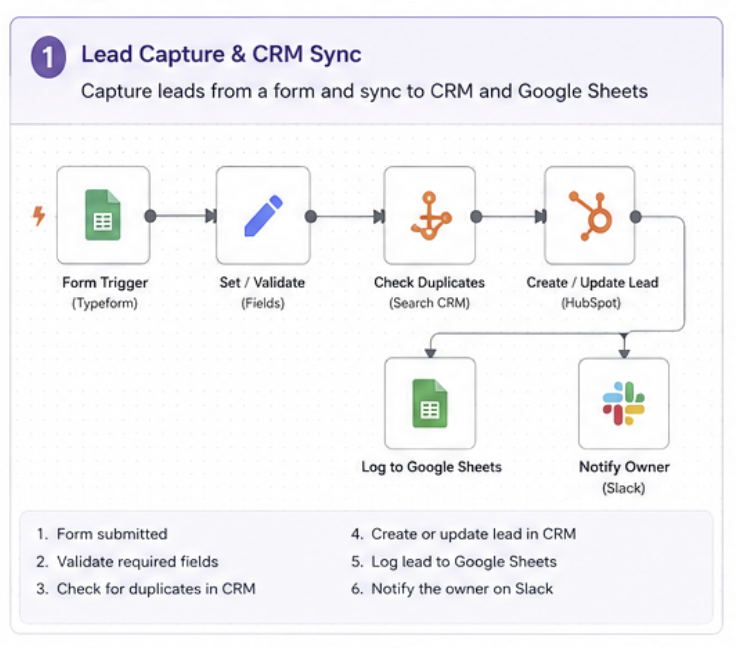
Form submissions validated, checked for duplicates, written to the CRM, logged, and the owner notified in Slack—no copy-paste triage, no missed follow-ups.
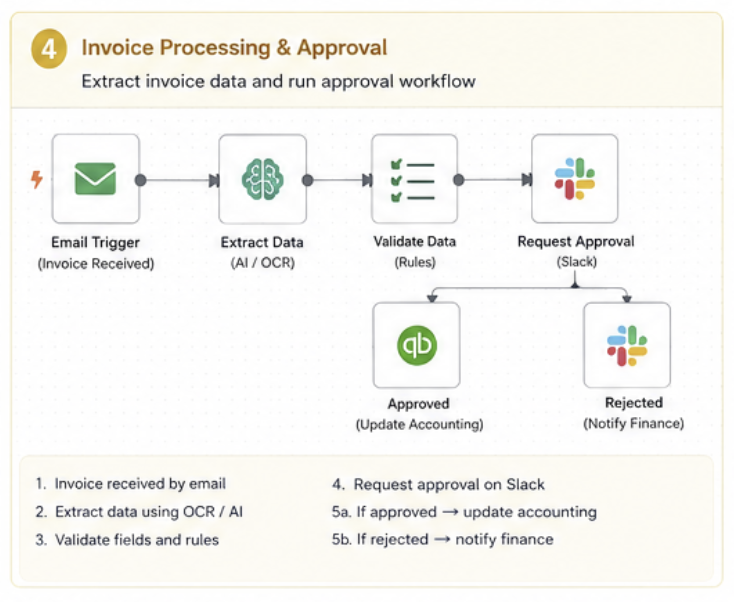
Incoming invoices parsed, validated against rules, routed for approval in Slack, and posted to accounting—an audit trail instead of an inbox.
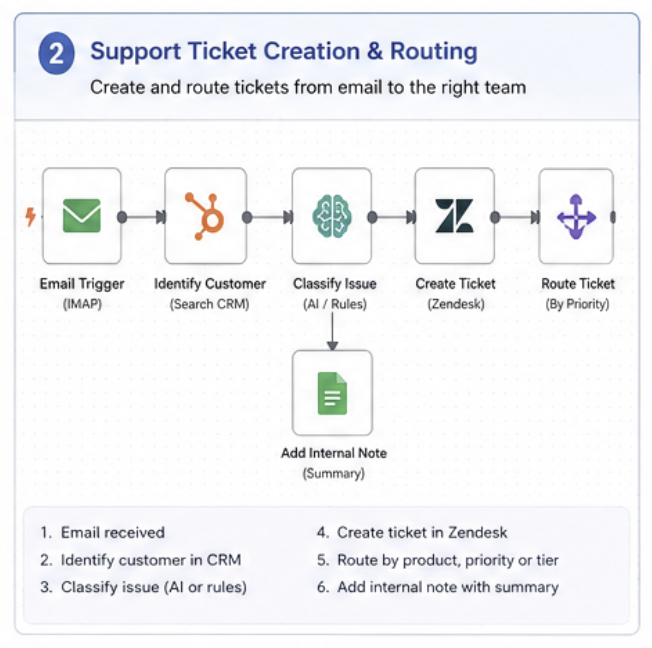
New requests matched to the customer record, classified, ticketed, and routed by priority—before anyone has to read the inbox.
Have a workflow like these—or one that should work like these?
Process
The aim is to prove value quickly, then make the automation easier to own, observe, and change.
Clarify systems, pain points, cost, owners, data, and the result the workflow must deliver.
Select quick wins and high-value automation before touching lower-impact work.
Create clean workflow logic, credentials, integrations, and handover notes.
Add useful errors, alerts, backup checks, recovery paths, and production controls.
Review failures, tune performance, remove drift, and keep the system dependable.
Platform fit
The most expensive option is not the default. Add governance, security, procurement, or scale controls only when the requirement is real.
Best for internal workflows and self-hosted environments with clear ownership.
Best when separation of duties, auditability, or multi-team control is required.
Why Strategy Guide Win
Reliability, credentials, logs, backups, failure modes, ownership, and maintainability are part of the design. Not an afterthought added when something breaks. That is the difference between automation your team owns and automation you hope keeps working.
Built around the work people actually do.
Clear enough for the next operator to follow.
Designed for change, not just launch day.
Spend follows the requirement, not the sales pitch.
Credentials and access handled deliberately.
Failures leave evidence and reach the right owner.
From the workshop — SGW Node
Separate from the consulting work: the SGW Datadog node brings monitors, events, and logs into n8n so SRE and platform teams can trigger, investigate, and audit workflows without hand-rolling every HTTP request. It is also proof of how we build—typed, documented, and made for production.
// monitor event enters n8n
{
  "monitor": "api-latency",
  "status": "alert",
  "service": "checkout",
  "workflow": [
    "collect_context",
    "notify_owner",
    "create_audit_event"
  ]
}Post a useful event to the Datadog event stream from an n8n workflow.
Query deploys, config changes, Watchdog findings, monitor events, and third-party activity.
Write workflow activity into Datadog log management for search and audit.
Fetch a monitor definition, status, and tags to drive controlled response logic.
A useful first conversation
SME operations, finance, and customer teams that depend on automation but do not have a dedicated platform team. If you run n8n, a pile of scripts, or a stack of paid automation subscriptions, the review fits.
A simple description of the process, the systems involved, who owns it, where it fails, and what the failure costs in time, money, or customer trust.
No. The review can assess an existing n8n estate, a collection of scripts, other automation tools, or a manual process that may be ready for automation.
Only where the requirement is real—such as SSO, role separation, auditability, external secrets, compliance, or multi-team governance.
You receive a clear view of the risks, quick wins, priorities, and practical next step. That may be a focused fix, a sprint, a buildout, or no project at all.
Next step
Book a 30-minute review of one real workflow. You leave with the risks, the quick wins, and a priority order—whether or not we work together afterwards.